Ethiopian Airlines: How Africa Built a World-Class Carrier While The World Wasn't Watching

A Competitive Case Study | GBSH Consult Group
Ethiopian Airlines is the most profitable airline on the African continent, the fastest-growing carrier in the developing world, and one of the few state-owned enterprises anywhere on earth that is genuinely, consistently, commercially excellent.
It operates in the same continent as airlines that have collapsed, been bailed out, renationalised, and collapsed again. It competes on intercontinental routes against Emirates, Qatar Airways, Turkish Airlines, and Lufthansa. And it is winning.
The question is not whether Ethiopian Airlines is exceptional. The data says it is. The question is why, and what every African government, SOE board, and private sector leader should be learning from the answer.
SECTION 1: THE FINANCIAL ANALYSIS
Revenue Growth: A 20-Year Compounding Story
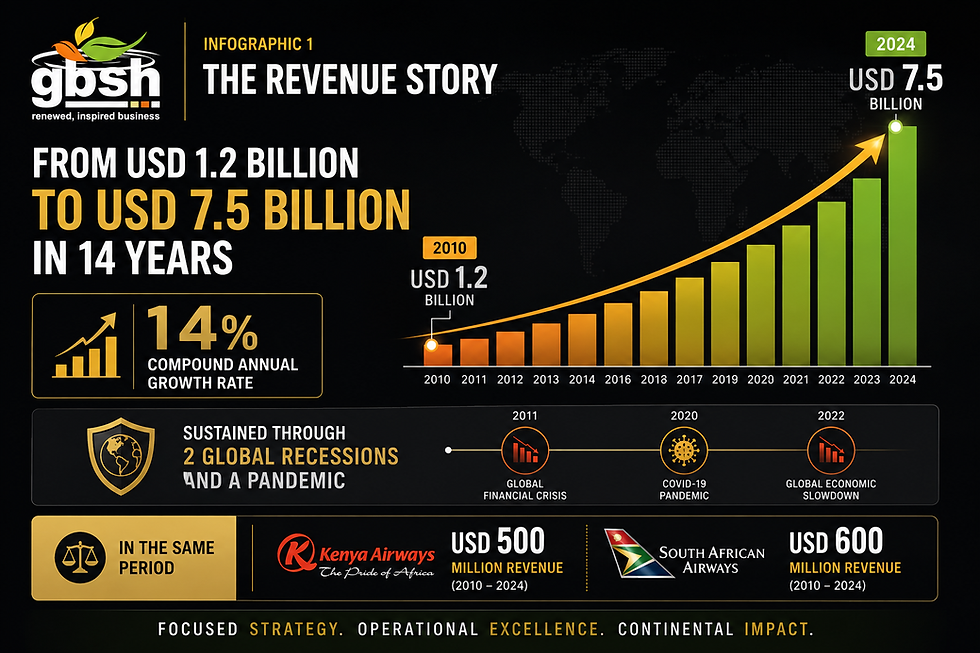
Ethiopian Airlines generated approximately USD 7.5 billion in revenue in its 2023/24 financial year. In 2010 it generated USD 1.2 billion. That is a six-fold increase in 14 years, a compound annual growth rate of approximately 14% sustained across two global recessions, a pandemic that grounded 95% of global aviation, and an armed conflict on its own soil.
To contextualise that number: Kenya Airways reported revenue of approximately USD 500 million in the same period. SAA, after its business rescue and relaunch, reported revenue of approximately USD 600 million. Ethiopian Airlines is not marginally ahead of its African peers. It is in a structurally different financial category.
Profitability Through Crisis
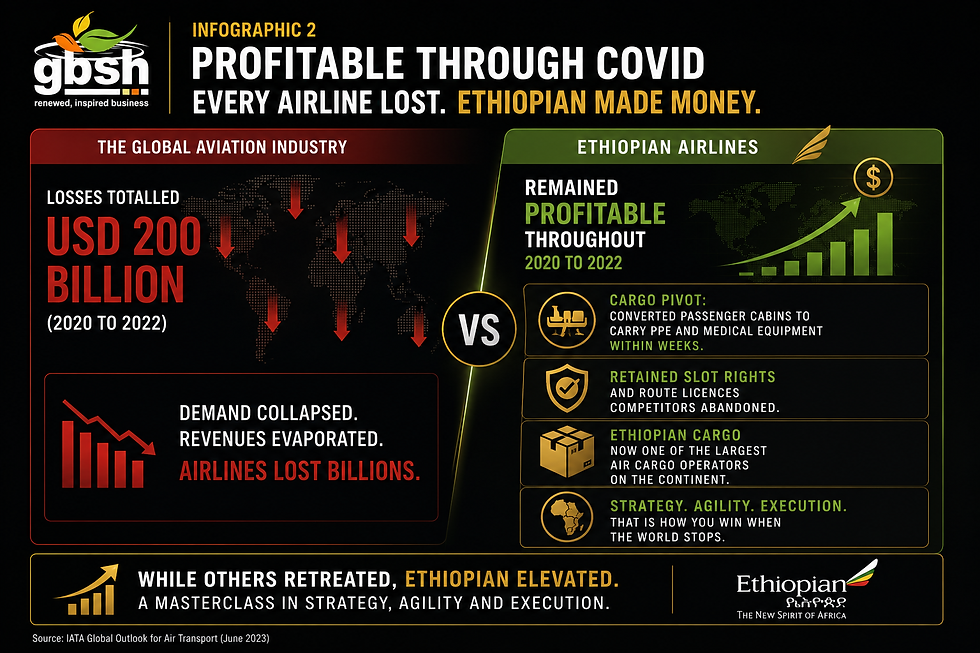
The most revealing financial period for any airline is not the good years. It is COVID-19. Between 2020 and 2022, global aviation lost an estimated USD 200 billion. Major carriers collapsed. Dozens of airlines went into administration. Ethiopian Airlines remained profitable throughout.
It did so through three mechanisms.
First, it pivoted its widebody passenger fleet to cargo operations within weeks of borders closing, converting passenger cabin space to carry medical equipment, PPE, and pharmaceuticals on cargo charter contracts when passenger demand collapsed entirely.
Second, it maintained skeleton passenger operations on critical routes while competitors withdrew, retaining slot rights and route licences that would have been costly to recapture.
Third, it used the low-demand period to accelerate fleet maintenance and crew training that would have been operationally disruptive during normal operations.
The cargo pivot alone generated revenue that offset a significant portion of the passenger revenue loss. Ethiopian Cargo and Logistics Services is now one of the largest air cargo operators on the continent, a business built opportunistically during the crisis and retained as a permanent profit centre.
The Balance Sheet Advantage
Ethiopian Airlines carries debt. No airline of its scale does not. But its debt is project-financed against specific assets: fleet acquisition, the Addis Ababa airport expansion, the aviation academy. It is not the emergency working capital debt that has characterised SAA's balance sheet for two decades.
SAA's ZAR 30 billion in government bailouts between 2017 and 2021 was not investment in growth. It was the cost of keeping an operationally dysfunctional airline alive long enough for the next restructuring attempt. Ethiopian's debt funds expansion. SAA's debt funded survival. That distinction is the entire financial story of African aviation in one sentence.
The Cargo and Ancillary Revenue Model
Ethiopian generates revenue across six business units: passenger, cargo, MRO (Maintenance, Repair and Overhaul), ground handling, catering, and the aviation academy. This diversification is deliberate and strategically significant.
Most African airlines are single-product businesses: they sell seats. When seat demand falls, revenue falls. Ethiopian has built a portfolio of aviation-adjacent revenue streams that are either counter-cyclical to passenger demand or independent of it entirely. Collectively, these ancillary businesses contribute an estimated 25 to 30% of group revenue.
They also create switching costs. An airline that uses Ethiopian's MRO services, trains its crew at the Ethiopian academy, and relies on Ethiopian's ground handling at Addis becomes operationally embedded in the Ethiopian ecosystem in ways that deepen the relationship beyond the competitive route network.
SECTION 2: THE COMPETITOR ANALYSIS
Ethiopian Airlines vs Kenya Airways: The Cautionary Parallel
Kenya Airways and Ethiopian Airlines launched from roughly equivalent positions in the 1970s and 1980s. Both were East African flag carriers with regional ambitions. Both served the same growing African middle class. The divergence since then is one of the most instructive case studies in African corporate governance.
Kenya Airways was privatised in 1996, with KLM taking a 26% strategic stake in what was seen at the time as a model for African airline transformation. For a period in the early 2000s, KQ was genuinely competitive. The problems accumulated slowly. KLM's influence waned as commercial logic was progressively subordinated to political considerations around route decisions, pricing, and senior appointments. KLM eventually exited its stake entirely.
The fleet expansion of the 2010s, Project Mawingu, an ambitious long-haul strategy, was funded with debt the revenue base could not service. The long-haul routes underperformed. The debt did not. By 2017 KQ was technically insolvent, posting losses of USD 250 million in a single year.
Today Kenya Airways operates 44 aircraft against Ethiopian's 130+.
The specific lessons:
Partial privatisation with retained political control produces the worst of both worlds.
Fleet expansion must be funded by demonstrated revenue, not projected revenue.
Strategic partnerships with global carriers require genuine commercial autonomy to function.

Ethiopian Airlines vs South African Airways: The Governance Collapse in Detail
At its peak in the early 2000s, SAA operated 57 aircraft, flew to 38 international destinations, and was genuinely competitive on Africa-to-Europe and Africa-to-North America routes. It had Star Alliance membership. It had the balance sheet of a carrier backed by Africa's most sophisticated economy.
Between 2010 and 2020, SAA received ZAR 21.7 billion in direct government guarantees and bailouts, before the business rescue process that added a further ZAR 10.5 billion. In total, South African taxpayers have transferred approximately ZAR 32 billion to an airline that responded by shrinking its fleet, cutting its route network, losing its Star Alliance membership, and entering formal business rescue in 2019.
The mechanism of destruction was not a single decision. Routes were retained because of ministerial preference rather than yield data. Procurement decisions were made to benefit connected suppliers. Senior appointments were made on political loyalty rather than aviation competence. Fuel hedging strategies were abandoned under political pressure.
Ethiopia is a significantly poorer country than South Africa by GDP per capita. Its domestic market is smaller. Its sovereign balance sheet is weaker. And yet Ethiopian Airlines has built a USD 7.5 billion revenue business while SAA has consumed ZAR 32 billion of a far wealthier sovereign's resources and contracted to a fraction of its former scale. The variable is not resources. It is governance.
Ethiopian Airlines vs Emirates: The Benchmark and Its Limits
Emirates is the airline that Ethiopian's Vision 2035 is consciously benchmarked against. Both are wholly state-owned. Both use geographic position as a hub arbitrage strategy. Both have invested aggressively in fleet and product.
The differences are equally real. Emirates operates with the backing of one of the world's wealthiest sovereign wealth funds. Ethiopian does not have that sovereign backstop. What it has instead is operational efficiency, cost discipline, and a network that serves a market Emirates cannot fully serve: the intra-African passenger who is not routing through the Gulf.
The frontier on which Ethiopian is genuinely competing with Emirates and winning is African city pairs that Emirates serves only via Dubai. Addis to Lagos via Addis is a shorter journey than Addis to Lagos via Dubai. That geographic logic, multiplied across 125+ destinations, is where Ethiopian's network becomes genuinely defensible even against Gulf capital.
Ethiopian Airlines vs Turkish Airlines: The Most Dangerous Competitor
Turkish Airlines has expanded its African network faster than any non-African carrier over the past decade. It now serves more African destinations than any other airline in the world, including Ethiopian. Istanbul's geographic position makes it a natural connecting hub for traffic that previously routed through London, Paris, or Frankfurt.
Turkish has used Istanbul Airport, one of the largest aviation hubs in the world by capacity, to undercut European legacy carriers on Africa-to-Europe routes while building African network density that makes Istanbul a credible alternative to Addis for continental connectivity.
Ethiopian's strategic response has been to deepen intra-African connectivity that Turkish cannot serve from Istanbul, compete aggressively on Africa-to-Asia where geography favours Addis, and accelerate the subsidiary airline strategy to capture West and Central African traffic at source.
The Turkish-Ethiopian competition is the most consequential dynamic in African aviation over the next decade. The outcome will be determined by which carrier builds the deeper intra-African network.
Ethiopian Airlines vs Qatar Airways: The Premium Threat
Qatar Airways competes on product quality, Business Class hard product, lounge infrastructure, and Oneworld alliance connectivity. The traveller Qatar targets in Africa is the executive and government client travelling on premium tickets. Ethiopian's Cloudnine Business Class product has improved significantly but has not closed the product gap with Qatar.
Ethiopian's competitive position in the premium segment rests on network breadth and Star Alliance connectivity. The threat Qatar poses is less about volume and more about yield. Losing the premium segment on high-traffic routes means retaining passengers but losing the revenue per seat that makes those routes most profitable.
Ethiopian Airlines vs Lufthansa Group: The European Legacy Retreat
The Lufthansa Group's African strategy has been defensive over the past decade. European legacy carriers have retreated from thin African routes as Gulf and Turkish competition eroded yields. What remains is the premium corporate and diplomatic travel segment.
More instructive is what Lufthansa's retreat reveals: the intra-African and secondary-city market that European carriers are abandoning is exactly the market Ethiopian is building into. The runway for Ethiopian's network expansion runs, in part, through routes that European carriers have decided are not worth defending.
SECTION 3: THE LEADERSHIP FACTORY PARADOX: WHEN COMPETITIVE ADVANTAGE BECOMES THE CONTINENT'S EXPORT
Ethiopian Airlines has built something that no business school curriculum teaches and no consulting firm can install: a genuine leadership factory. The proof is not a policy document or an organisational chart. It is five names.
Tewolde GebreMariam, Ethiopian Airlines CEO from 2011 to 2022 and the architect of the airline's most transformative decade, is now CEO of Air India, the Tata Group's flagship carrier and one of the most ambitious airline transformation projects in the world.
Mesfin Tasew Bekele, who succeeded him, continues to run the Ethiopian Airlines Group.
Laeke Tadesse leads the Ethiopian Aviation University, the institution that has trained pilots, engineers, and aviation managers across the African continent for decades.
Aman Wole Gurmu, Ethiopian-trained, is now CEO of Zambia Airways, one of Ethiopian's own subsidiary investments.
Girma Wake, a former Ethiopian CEO has taken the helm of Ugandan Airlines.

Read that list slowly. One institution produced the current CEO of the largest airline on the African continent, the CEO of one of the most capitalised airline transformation projects in the world, the president of the continent's most significant aviation academy, the CEO of a key subsidiary carrier, and the leader of another national airline.
Ethiopian Airlines is not just Africa's best airline. It is Africa's aviation leadership institution.
That is the compliment. Now here is the strategic question that nobody is asking loudly enough.
The Playbook Problem
Senior aviation executives do not leave with experience in the abstract. They leave with the playbook. Not just broad strategic philosophy, but specific, granular institutional knowledge: network strategy, route economics, fleet deployment logic, cargo operations architecture, cost discipline framework, hub management, alliance negotiation, and the management culture that built a USD 7.5 billion business from a USD 1.2 billion one in 14 years.
When that playbook moves to an airline serving overlapping markets, the competitive calculus changes in ways that do not show up immediately in financial results or lost market share.
The Air India Dimension
Tewolde's appointment to Air India is the case that deserves the most careful analysis. Air India under the Tata Group is a genuinely different proposition from the state-owned dysfunction it was for decades. It has private ownership, patient capital, transformation ambition, and a domestic market of 1.4 billion people behind it. Its explicit international ambition includes Africa, where Indian diaspora communities, rapidly growing trade flows, and the India-Africa diplomatic relationship create a natural and expanding passenger market.
Ethiopian Arilines has historically dominated India-Africa routing. The Addis hub's geographic position makes it the natural transfer point for passengers moving between the Indian subcontinent and the African continent. Ethiopian built that dominance through network investment, frequency, and the operational excellence that Tewolde helped architect over eleven years.
An Air India that combines Tata capital, Indian scale, international ambition, and the institutional knowledge of the person who built Ethiopian's India-Africa strategy is a competitive threat of a different order than anything Ethiopian has faced on that corridor before. It will not materialise overnight. But it is being built, by someone who knows exactly where the structural advantages lie and what it takes to displace them.
The Zambia and Uganda Dimension
Aman Wole Gurmu at Zambia Airways and the former Ethiopian CEO at Ugandan Airlines represent a different but equally important dynamic. Both carriers are Ethiopian subsidiary investments or strategic partners. Ethiopian-trained leadership running those carriers is, in that context, by design. It is the governance export model that Vision 2035 is built on.
But the governance export model only works if the subsidiary remains aligned with Ethiopian's strategic interests. The moment a subsidiary carrier's leadership develops enough institutional independence, or enough local political backing, to pursue a strategy that competes with rather than complements the Ethiopian network, the model faces a test it has not yet been required to pass.
Ethiopian trained the people now running Zambia Airways. Ethiopian trained the people now running Ugandan Airlines. What happens when those people, with all of Ethiopian's institutional knowledge, decide their national carriers should compete for the same intra-African passengers that Ethiopian's hub strategy depends on capturing?
This is not a hypothetical. It is the inevitable maturation arc of every hub-and-spoke network that builds its regional spokes through subsidiary equity rather than wholly-owned operations. The spokes eventually want to become hubs.
The Strategic Response
There is no clean resolution to this. Ethiopian Airlines cannot prevent former executives from taking other roles, nor should it try. The institutional reputation that makes Ethiopian executives attractive globally is inseparable from the culture that makes Ethiopian the airline it is.
The strategic response is not to stop the outflow. It is to ensure that what Ethiopian exports is always a generation behind what Ethiopian is currently building. An institution that is continuously compounding its competitive advantage exports its past, not its present. The former executives carry the playbook as it was written. Ethiopian Airlines must always be writing the next chapter before they arrive.
That requires continuous innovation in network strategy, operating model, technology deployment, and the management philosophy itself. The leadership factory paradox is only an existential threat if Ethiopian Airlines stops evolving. If the institution keeps compounding, every executive it exports is carrying a version of the model that Ethiopian has already moved beyond.
The deeper implication extends beyond aviation. This is the defining institutional challenge of every African organisation that aspires to continental relevance: how do you build talent at the scale the continent needs, export it generously into the ecosystem, and simultaneously stay ahead of what you taught?
Ethiopian Airlines has not solved this problem. But it is the first African institution to have built it in a form worth solving. That, in itself, is a form of excellence the continent has rarely seen.
SECTION 4: THE GOVERNANCE ARGUMENT
The Core Thesis
Ethiopian Airlines is a state-owned enterprise. So is SAA. So is Kenya Airways. The outcomes span from global excellence to bankruptcy. The determining variable is governance, specifically, the degree to which commercial logic is protected from political interference in operational decisions.
This is not an ideological argument for privatisation. Ethiopian Airlines is the proof that state ownership and commercial excellence are compatible. It is an argument for a specific governance architecture that African governments have consistently failed to build and sustain.

The Three Governance Variables
Variable One: Leadership Selection. Ethiopian Airlines has been led by career aviation professionals across every succession since the 1970s. Aviation competence is the threshold criterion. SAA over the same period has had finance professionals, lawyers, political figures, and administrators in the CEO role, with aviation professionals the exception. The acting-CEO problem, where the substantive role is occupied by someone in interim capacity for years, means no strategic continuity is possible.
Variable Two: Board Composition and Mandate. Ethiopian's board is constituted with a commercial mandate. Its members are accountable for financial performance. SAA's board was dissolved by the Minister of Public Enterprises in 2018, 2019, and again during business rescue. Board members who raised concerns about financial management were replaced with more compliant oversight. A board that can be dissolved when it becomes inconvenient is not a governance structure. It is a formality.
Variable Three: Operational Autonomy on Commercial Decisions. Ethiopian Airlines management decides which routes to fly based on yield data, not diplomatic convenience. It makes procurement decisions through a commercial evaluation process. It prices its seats to compete in the market. SAA's history is a catalogue of the reverse: routes retained for political reasons, procurement decisions investigated by parliamentary committees, pricing decisions overridden by ministerial instruction. The ZAR 32 billion bailout total is the approximate cost of what that interference delivered.
The Subsidiary Strategy as Governance Export
Ethiopian's Vision 2035 subsidiary airline model is, among other things, a governance export project. When Ethiopian takes an equity stake in a carrier in Zambia, Malawi, or Mozambique, it installs management systems, operational procedures, training standards, and a commercial decision-making culture insulated from the political environment of the host country.
This is governance arbitrage. If Vision 2035 is executed, Ethiopian Airlines will not just be Africa's best carrier. It will be the governance architecture for African aviation, the institutional structure through which commercial aviation logic is protected from political interference across a dozen national markets simultaneously.
That is not an airline strategy. That is a continental institutional development strategy disguised as a business plan.

THE GBSH PERSPECTIVE
Ethiopian Airlines proves three things that African governments and institutional leaders need to hear at full volume.
First: state ownership is not the problem. Governance is. The question is never who owns the asset. The question is who makes the decisions about the asset, on what basis, and with what accountability for the outcomes.
Second: long-term commercial discipline compounds. The decisions Ethiopian made in 2005, fleet investment, hub infrastructure, academy development, intra-African network building, are the decisions that produced the USD 7.5 billion revenue line and the 130-aircraft fleet in 2025. The returns on institutional discipline are not visible in the quarter they are made. They are visible two decades later.
Third: governance is exportable. The subsidiary model Ethiopian is building is proof that commercial institutional culture can be transferred through equity structures. African development institutions, governments, and private sector leaders should be studying it carefully, not because aviation is uniquely important, but because the governance mechanism is transferable to every sector where state ownership and commercial performance are in tension.
The continent has the resources. The market. The demographics. The growth trajectory.
What it is still building, in aviation as in investment, in infrastructure as in enterprise, is the institutional architecture that converts those raw advantages into compounding returns.
Ethiopian Airlines is what that architecture looks like when it works.
GBSH Consult Group | Pan- African Strategic Advisory
GBSH Consult Group is a global strategic advisory firm specialising in investment advisory, public-private partnership structuring, human capital governance, and executive leadership. Headquartered in Johannesburg, GBSH advises governments, development finance institutions, and private sector leaders across the African continent.



Comments